Revelation Revealed

by Christine Miller | Nothing New Press

  • Book Extras Home
  • Table of Contents
    • Introduction
      • Design of Revelation
    • The Things Which Are
      • Revelation 1
      • Revelation 2-3
      • Revelation 4-5
    • Seals Opened
      • Revelation 6
      • Revelation 7
    • Trumpets Blown
      • Revelation 8
      • Revelation 9
      • Revelation 10
      • Revelation 11
    • Identities Revealed
      • Revelation 12
      • Revelation 13
      • Revelation 14
    • Bowls Poured out
      • Revelation 15
      • Revelation 16
      • Revelation 17
      • Revelation 18
    • Return of the King
      • Revelation 19
      • Revelation 20
      • Revelation 21
      • Revelation 22
    • Appendices
      • Teaching Tools
      • Precedent of Daniel
      • Marked on Hand…
      • Chiastic Structure
      • Outline of History
      • FAQs
      • Bibliography
  • About the Author
  • Buy the Book
You are here: Home / Archives for Christine Miller

The German Confederation of States

July 18, 2016 by Christine Miller Leave a Comment

Germany did not exist as such, but there was a German Confederation of States (formed by the Congress of Vienna at the end of the Napoleonic wars) made up of Prussia, Austria, Bavaria, Saxony, and so on, each still with its duke, prince, or king at its head.
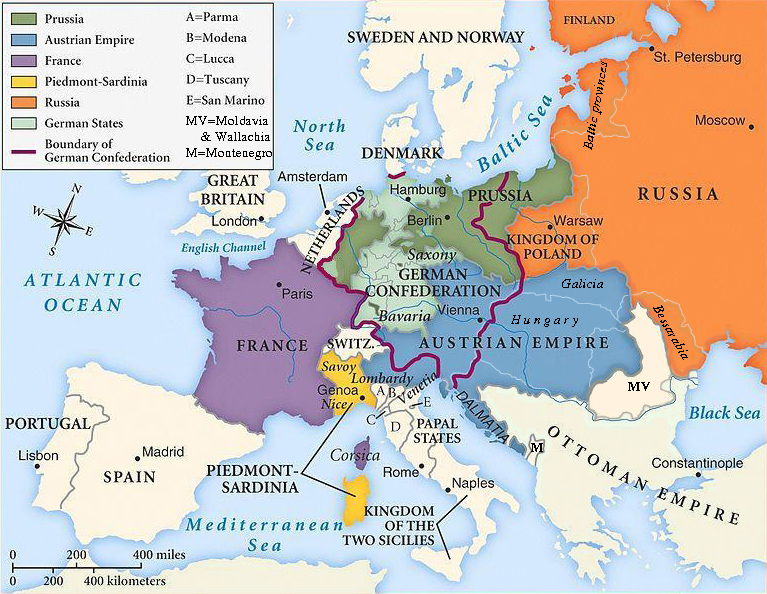
Europe in 1815 | revelationrevealed.online
THE NATIONAL BOUNDARIES WITHIN EUROPE AS SET BY THE CONGRESS OF VIENNA, 1815. By The International Commission and Association on Nobility. Public Domain, https://commons.wikimedia.org/w/index.php?curid=12104648

Absolutism Restored in Europe

July 18, 2016 by Christine Miller Leave a Comment

After Napoleon, kings and nobles were restored in Europe, who were even more absolutist than before. Their fear of fresh revolutions caused them to discourage liberal ideas and reform to an even greater degree than would be usual.

“For nearly forty years the idea of the Holy Alliance, the Concert of Europe which arose out of it, and the series of congresses and conferences that succeeded the concert, kept an insecure peace in war-exhausted Europe. Two main things prevented that period from being a complete social and international peace, and prepared the way for the cycle of wars between 1854 and 1871. The first of these was the tendency of the royal courts concerned, towards the restoration of unfair privilege and interference with freedom of thought and writing and teaching. … The obstinate disposition of Monarchy to march back towards past conditions was first and most particularly manifest in Spain. Here even the Inquisition was restored.”

H. G. Wells, Outline of History, Part II, 37.6, “The Map of Europe in 1815.”

The German Empire (Second Reich)

July 18, 2016 by Christine Miller Leave a Comment

In the wake of the collapse of the Holy Roman Empire, which was known in Germany as the First Reich, the German nobles created out of the Confederation of German States, the German Empire, or Second Reich, with Wilhelm, king of Prussia, as Emperor, in 1871. (Ten Horns, pg. 263).

“William [of Prussia], in 1861, succeeded to the crown. The autocratic spirit of King William was shown at his coronation. ‘The kings of Prussia,’ he said, ‘receive their crowns from God.’ … The King dissolved the House of Representatives [of the German Confederation], and called to his aid Otto von Bismark-Schönhausen, a gentleman of Brandenburg, known for his distrust of parliamentary institutions and his devotion to the principle of absolute rule. The policy of Bismark became the policy of the crown. Together King WIlliam and his minister created the Germany of to-day [written in 1903]. … ‘It is not Prussia’s liberality that Germany looks to, but her military power,’ said Bismark; and again: ‘The unity of Germany is to be brought about not by speeches, nor by the voice of majorities, but by blood and iron.’ …

“The union of Germany under Prussian leadership was accomplished by means of three wars: one with Denmark in 1864; the second with Austria in 1866; and the third with France in 1870. … [At the conclusion of the French war] In the Hall of Mirrors of the palace of Versailles, surrounded by a victorious army, the King of Prussia was crowned Emperor in the presence of the German sovereigns (January 18, 1871) receiving the crown ‘from himself and his equals.’ The Empire included all the German lands, save those of Austria.”

Merrick Whitcomb, A History of Modern Europe, pp. 214-218.

Proclamation of Wilhelm I of Prussia, German Emperor by Anton von Werner | revelationrevealed.online
PROCLAMATION OF KING WILHELM I AS GERMAN EMPEROR AT VERSAILLES. By Anton von Werner. Housed at Museen Nord / Bismarck Museum: Picture, Public Domain, https://commons.wikimedia.org/w/index.php?curid=2481294

European Uprisings in 1848

July 18, 2016 by Christine Miller Leave a Comment

The failure of the French Revolution to produce any lasting change, the even deeper entrenchment of absolutist kings and nobles in Europe, and a growing knowledge of unprecedented personal freedom and opportunity of immigrants to America, not enjoyed by their family members still remaining in Europe, led to a series of uprisings of the people against their absolutist rulers in 1848.

“The history of Europe, then, from 1815 to 1848 was, generally speaking, a sequel to the history of Europe from 1789 to 1814. There were no really new motifs in the composition. The main trouble was still the struggle, though often a blind and misdirected struggle, of the interests of ordinary men against the Great Power system which cramped and oppressed the life of mankind.”

H. G. Wells, Outline of History, Part II, The Realities and Imaginations of the Nineteenth Century: The Fermentation of Ideas, 1848, 38.3

Ottoman Reforms

July 18, 2016 by Christine Miller Leave a Comment

Beginning in 1839, the Ottoman Empire began to enact reforms for its citizens which the citizens of the Roman beast in the rest of Europe could only dream of.

“In the reform movements and activities of the nineteenth century two distinct trends can be discerned, between which there was continuous struggle. One derived from the Central European Enlightenment, and brought ideas which were welcome and familiar to authoritarian reformers. They too, like their Central European models, knew what was best for the people and did not wish to be distracted by so-called popular government from the business of applying it. The inert masses, accustomed by ancient tradition to follow and to obey, could not yet, according to this view, be entrusted with their own fate but had to be taught and commanded by those whose historic function it is to teach and to command — that is, the intellectuals and the solders.

The other view drew its inspiration from Western rather than Central Europe, and was inspired by doctrines of political and, to a lesser extent, economic liberalism. For the disciples of this trend, first in Turkey and then in other countries, the people had rights which were to be secured, along with the general advancement of the country, by means of representative and constitutional government. Freedom was seen as the true basis of Western power, wealth, and greatness. … The importation, adaptation, and in some measure application of these ideas [of individual freedom] constitute one of the major political developments of the nineteenth and early twentieth centuries.

“The first tentative experiments with consultative councils and assemblies, all appointed, date back to the early nineteenth century, when both in Turkey and in Egypt councils of this kind were convened to discuss such matters as agriculture, education, and taxes. In 1845 the Ottoman sultan even convened an assembly of provincial representatives, two to be chosen from each province, ‘from among those who are respected and trusted, are people of intelligence and knowledge, who know the requisites of prosperity and the characteristics of the population.’ Despite these fine qualifications the experiment led nowhere and was abandoned.”

Bernard Lewis, The Middle East: A Brief History of the Last 2000 Years, pp. 311-12.

« Previous Page
Next Page »

Search

Newest Notes

  • On the abuse of papal authority
  • Revelation 5 Chiastic Structure
  • Revelation 4 Chiastic Structure

Table of Contents

  • Introduction
  • The Design of Revelation
  • Revelation 1
  • Revelation 2-3
  • Revelation 4-5
  • Revelation 6
  • Revelation 7
  • Revelation 8
  • Revelation 9
  • Revelation 10
  • Revelation 11
  • Revelation 12
  • Revelation 13
  • Revelation 14
  • Revelation 15
  • Revelation 16
  • Revelation 17
  • Revelation 18
  • Revelation 19
  • Revelation 20
  • Revelation 21
  • Revelation 22
  • Appendices
  • Bibliography

Get updates on new posts:

Click here to subscribe to email updates.

Join the discussion:


Join the official discussion page here.

Notice

THE FACTS AND DATES of these events, not specifically annotated, were all checked for accuracy with the Encyclopaedia Britannica: Eleventh Edition (New York City: Cambridge England University Press, 1910).

ALL RIGHTS RESERVED. This website is protected under United States and International copyright law. No portion of this website may be reproduced, stored in a retrieval system, or transmitted in any form or by any means–electronic, mechanical, photocopy, recording, scanning, or other–except for brief quotations in critical reviews or articles, without the prior written permission of the publisher.

SCRIPTURE QUOTATIONS are from the World English Bible (public domain), unless otherwise noted.

Books by Christine

Award-winning histories:
All Through the Ages
Guerber's Histories
The Law of Love

Contact

Nothing New Press
P.O. Box 18335
Sarasota, FL 34276
info@nothingnewpress.com

Hours

Monday ~ Friday
8am-5pm EST
Closed for posted holidays
Visit Nothing New Press

Our Family of Websites: NothingNewPress.com | aLittlePerspective.com | Classical-Homeschooling.org | BiblicalHomeschooling.org

Copyright © 2025 · NothingNewPress · Website by e9designs

Copyright © 2025 · Beautiful Pro Theme on Genesis Framework · WordPress · Log in