Revelation Revealed

by Christine Miller | Nothing New Press

  • Book Extras Home
  • Table of Contents
    • Introduction
      • Design of Revelation
    • The Things Which Are
      • Revelation 1
      • Revelation 2-3
      • Revelation 4-5
    • Seals Opened
      • Revelation 6
      • Revelation 7
    • Trumpets Blown
      • Revelation 8
      • Revelation 9
      • Revelation 10
      • Revelation 11
    • Identities Revealed
      • Revelation 12
      • Revelation 13
      • Revelation 14
    • Bowls Poured out
      • Revelation 15
      • Revelation 16
      • Revelation 17
      • Revelation 18
    • Return of the King
      • Revelation 19
      • Revelation 20
      • Revelation 21
      • Revelation 22
    • Appendices
      • Teaching Tools
      • Precedent of Daniel
      • Marked on Hand…
      • Chiastic Structure
      • Outline of History
      • FAQs
      • Bibliography
  • About the Author
  • Buy the Book
You are here: Home / Archives for Christine Miller

War and Revolution Weaken the Ottoman Empire

July 17, 2016 by Christine Miller Leave a Comment

However, war began to weaken the Empire. Uprisings in Ottoman-controlled holdings in Europe took place in the 19th century as they did in the rest of Europe against the Roman powers. The Ottomans began losing political power.

“The government’s problems of financial insolvency were now aggravated by those of internal revolt. Provoked by a bad harvest and the subsequent extortions of the imperial tax farmers, an insurrection against the local authorities erupted in Herzegovinia. It spread to Bosnia, where civil war soon raged between Crescent and Cross. Both Montenegro and Serbia … intervened with armed bands, and in the summer of 1876 the fire of revolt spread at the instigation of the rest to Bulgaria. Here in fact was the start of a Balkan revolutionary movement which was to lead, through the next generation, to one war after another and eventually to transform the whole face of the Balkan peninsula.”

Lord Kinross, The Ottoman Centuries: The Rise and Fall of the Turkish Empire, pg. 509.

“Serbia is called the ‘Peasant Nation.’ Its ancient native aristocracy was lost in the conquest by the Turks, and replaced with Musselmans [Muslims], who settled as conquerors in the country. … In 1876, excited by the revolt of Christians in Herzegovinia, Serbia declared war against Turkey. Conquered and overrun, she was saved by European intervention; but during the Russian invasion of Turkey in 1877 Serbia reopened the war. The Peace of Berlin [1878] gave her greater territory and complete independence …”

Merrick Whitcomb, A History of Modern Europe, pp. 271-272.

“In the autumn [of 1877], Europe was startled by the news of a great and decisive Russian victory over the Turks. On October 14 and 15 the Turks lost at one blow all the fruits of a long and brilliant series of victories in Armenia. On the 14th, [Russian] General Lazarov outflanked the right of the Turkish army … and the next day the Grand Duke Michael attacked the centre of the Turkish position with overwhelming force, while General Lazarov assaulted the rear. By 9 P.M. twenty-six battalions with seven pashas had surrendered with thirty-six guns. The Turkish stronghold on Mount Acolias was taken and the army cut in two. The right wing was compelled to lay down its arms, while … the left wing retreated … The spoil was great, including thousands of tents and standards, and immense quantities of ammunition. The remnant of … the army took up a strong position … before Erzeroum, from which it was driven in wild confusion on November 4 … On November 18, the famous fortress of Kars was taken by assault after a desperate conflict which raged for twelve hours. The Turks lost 5,000 in casualties, 300 cannon, and 10,000 prisoners.”

Edwin Emerson, Jr., A History of the Nineteenth Century, Year by Year, Vol. 3, pp. 1578-1579.
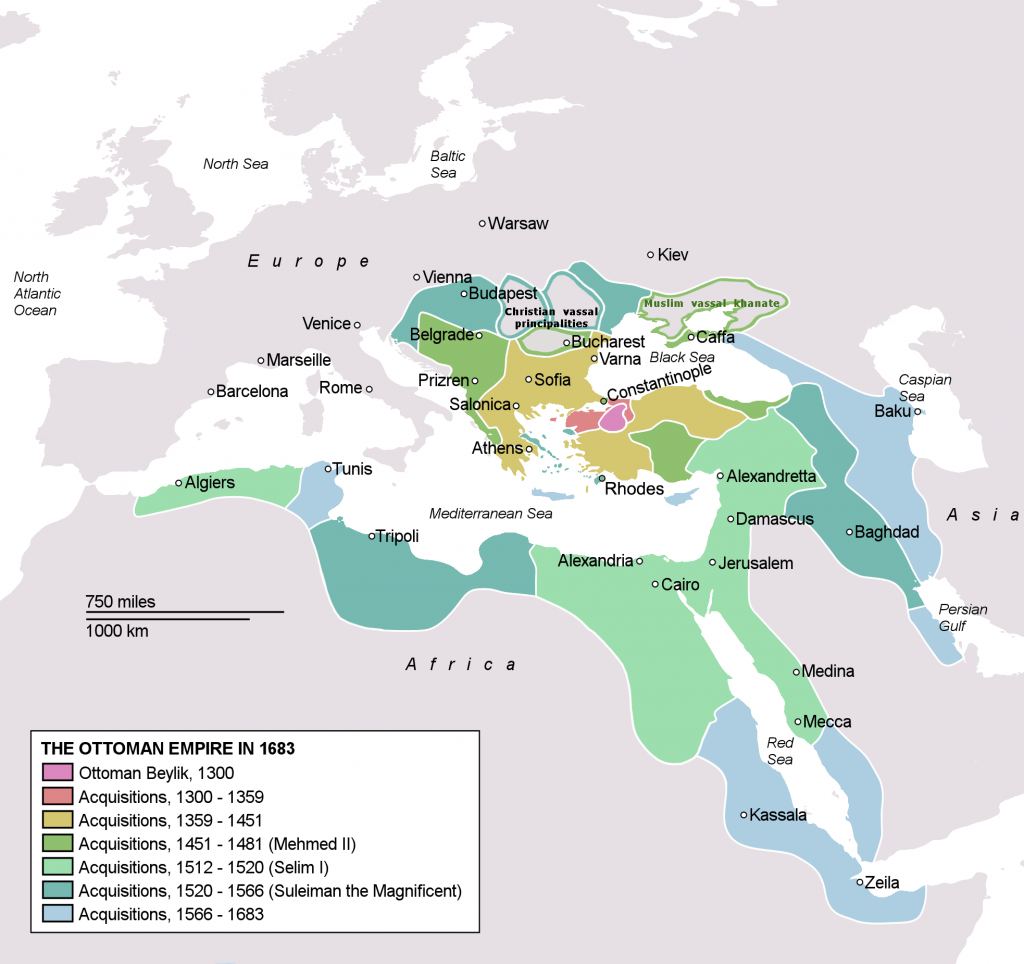
The Ottoman Empire at its Greatest Extent

July 17, 2016 by Christine Miller Leave a Comment

At its greatest extent, the Ottoman Empire of the Turks extended from Algeria in the west to Azerbaijan in the east, from the border of Austria in the north to Yemen, Africa in the south.

Ottoman Empire in 1683 | revelationrevealed.online
By Atilim Gunes Baydin – Self drawn, mainly based on Robert Mantran (ed.), Histoire de l’Empire Ottoman, Paris: Fayard (1989), also en:List of Ottoman Empire dominated territories, Image:Ottoman 1683.png, [1], and [2]. Background map modified from Image:A large blank world map with oceans marked in blue. … Public Domain, https://commons.wikimedia.org/w/index.php?curid=1481708

Who Were the Nicolaitans?

July 15, 2016 by Christine Miller Leave a Comment

Nicolaitans were disciples of the deacon Nicolaus, and while not much is known of them from Scripture, the writings of the early church fathers mention them. They were said to lead lives of unrestrained indulgence …

“Irenaeus (Adv. Hoeres. i. 26) says that their characteristic tenets were the lawfulness of promiscuous intercourse with women, and of eating things offered to idols. Eusebius (Hist. Eccl. iii. 29) states substantially the same thing … Tertullian speaks of the Nicolaitanes as a branch of the Gnostic family, and as, in his time, extinct.”

Albert Barnes, Notes on … Revelation, p. 67.

“The Nicolaitans are mentioned as a licentious sect in the Rev 2:6, 2:15. They claimed as their founder Nicolaus, a proselyte of Antioch and one of the seven deacons of the congregation of Jerusalem (Act 6:5). … But the views of the fathers are conflicting. Irenaeus (who is followed substantially by Hippolytus) gives a very unfavorable account. ‘The Nicolaitanes,’ he says, ‘are the followers of that Nicolaus who was one of the seven first ordained to the diaconate by the apostles. They lead lives of unrestrained indulgence. The character of these men is very plainly pointed out in the Apocalypse of John, where they are represented as teaching that it is a matter of indifference to practice adultery, and to eat things sacrificed to idols. Wherefore the Word has also spoken of them thus: “But this thou hast, that thou hatest the deeds of the Nicolaitanes, which I also hate.”’ Clement of Alexandria says that Nicolaus was a faithful husband, and brought up his children in purity, but that his disciples misunderstood his saying (which he attributes also to the Apostle Matthias), ‘that we must fight against the flesh and abuse it.’”

Philip Schaff, History of the Christian Church, Vol. 2, p. 416.

Revelation 16:3 Endnotes

July 15, 2016 by Christine Miller Leave a Comment

The Naval Might of France
Roman Naval Power Dealt a Death Blow

Reformation in France Severely Discouraged

July 14, 2016 by Christine Miller Leave a Comment

Because the Reformation had been severely discouraged in France, Bibles in French were rare, and the common people continued for the most part in ignorance of the Scripture.

The war against the Reformation was begun anew in France in 1685 when Louis XVI’s great-grandfather, Louis XIV, the Sun King, revoked the Edict of Nantes which guaranteed certain rights to the Protestants, and made Protestantism illegal. Some of the most learned and industrious men of French society had become Protestants, and they were persecuted so fiercely, that France bled its best and brightest to other countries whence they fled, or consigned them to tortures and dungeons until death claimed them.

See Wikipedia, “Edict of Nantes,” <http://en.wikipedia.org/wiki/Edict_of_Nantes>.

“The edicts of the king [Louis XIV] threatened books as well as persons with extermination. The Archbishop of Paris had compiled a list of works which the faithful could not read but at the risk of deadly injury. With this list in his hand the officer entered every suspected house, and whenever he found a forbidden book, he instantly destroyed it. … The records of Synods, and the private papers and books of pastors, were the first to be destroyed. Wherever a Bible was found, it was straightway given to the flames.”

J. A. Wylie, The History of Protestantism, Book 22: Protestantism in France From the Death of Henry IV (1610) to the Revolution (1789), Ch. 6, “The Prisons and the Galleys.”

The entire twenty-second volume of Wylie’s History is recommended for anyone wishing to dig deeper into the spiritual life of France preceding the Revolution.

« Previous Page
Next Page »

Search

Newest Notes

  • On the abuse of papal authority
  • Revelation 5 Chiastic Structure
  • Revelation 4 Chiastic Structure

Table of Contents

  • Introduction
  • The Design of Revelation
  • Revelation 1
  • Revelation 2-3
  • Revelation 4-5
  • Revelation 6
  • Revelation 7
  • Revelation 8
  • Revelation 9
  • Revelation 10
  • Revelation 11
  • Revelation 12
  • Revelation 13
  • Revelation 14
  • Revelation 15
  • Revelation 16
  • Revelation 17
  • Revelation 18
  • Revelation 19
  • Revelation 20
  • Revelation 21
  • Revelation 22
  • Appendices
  • Bibliography

Get updates on new posts:

Click here to subscribe to email updates.

Join the discussion:


Join the official discussion page here.

Notice

THE FACTS AND DATES of these events, not specifically annotated, were all checked for accuracy with the Encyclopaedia Britannica: Eleventh Edition (New York City: Cambridge England University Press, 1910).

ALL RIGHTS RESERVED. This website is protected under United States and International copyright law. No portion of this website may be reproduced, stored in a retrieval system, or transmitted in any form or by any means–electronic, mechanical, photocopy, recording, scanning, or other–except for brief quotations in critical reviews or articles, without the prior written permission of the publisher.

SCRIPTURE QUOTATIONS are from the World English Bible (public domain), unless otherwise noted.

Books by Christine

Award-winning histories:
All Through the Ages
Guerber's Histories
The Law of Love

Contact

Nothing New Press
P.O. Box 18335
Sarasota, FL 34276
info@nothingnewpress.com

Hours

Monday ~ Friday
8am-5pm EST
Closed for posted holidays
Visit Nothing New Press

Our Family of Websites: NothingNewPress.com | aLittlePerspective.com | Classical-Homeschooling.org | BiblicalHomeschooling.org

Copyright © 2025 · NothingNewPress · Website by e9designs

Copyright © 2025 · Beautiful Pro Theme on Genesis Framework · WordPress · Log in